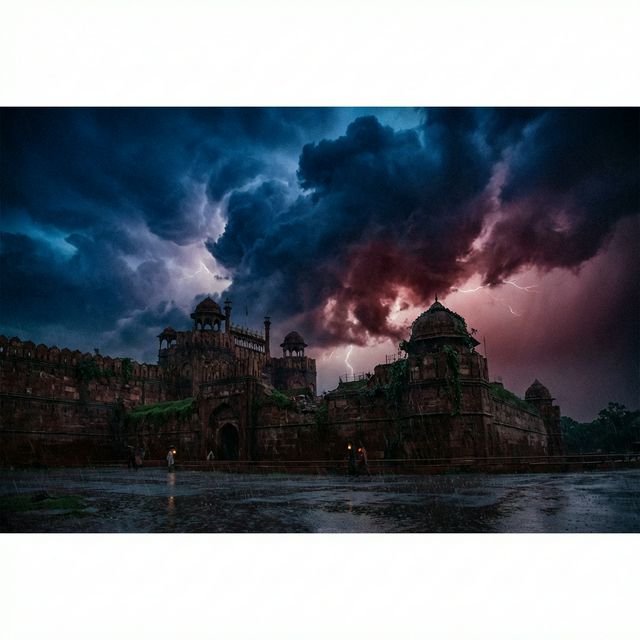
Dramatic scene of the Red Fort in Delhi at dusk, storm clouds overhead, symbolizing the fall of the Mughal Empire — deep indigo and midnight blue sky with crimson undertones

Bahadur Shah Zafar The Last Mughal — Freedom Fighter or British Puppet?

Glorified as a romantic poet-king and freedom fighter. But what do the historical records actually reveal? A comprehensive, source-backed examination of the last Mughal emperor, the 1857 revolt, and the 300-year Mughal legacy India still carries today.

Scroll to explore
📊 The Real Numbers

What They Don't Tell You

Behind the romanticized poetry and glorified narratives lie documented facts that paint a very different picture of the last Mughal emperor.

💰
0
British Pension Received
Monthly stipend from East India Company
📅
0
Years as Titular Emperor
1837–1857: Power confined to Red Fort walls
âš”ī¸
0
Europeans Massacred in Delhi
During the 1857 revolt under his nominal command
đŸ›ī¸
0
Years of Mughal Rule in India
1526–1857: A legacy of conquest and exploitation
🧭 Your Journey Through History

What This Encyclopedia Covers

Navigate through each chapter to uncover the layers of truth that have been systematically glorified, romanticized, or whitewashed in mainstream narratives.

📖
The romantic poet-king narrative vs. documented reality
Chapter 1

The Glorified Narrative

How Bollywood, textbooks, and popular culture have created a romanticized image of Bahadur Shah Zafar as a tragic freedom fighter. See the truth they hide.

Uncover the truth →
📅
87 years of a life — from birth to exile in Rangoon
Chapter 2

Timeline of Events

An interactive chronological walk through every major event — from his birth in 1775 to his death in exile in 1862 CE. What really happened at each stage.

Walk through time →
âš”ī¸
The 1857 revolt — massacres, betrayal, and chaos
Chapter 3

The 1857 Revolt

What actually happened in Delhi in 1857. The massacres of civilians, Zafar's secret letters to the British, and how his "leadership" was anything but heroic.

Read the accounts →
đŸ›ī¸
300+ years of Mughal conquest and cultural imposition
Chapter 4

The Mughal Legacy

Beyond one emperor — the 300-year Mughal legacy of temple destruction, Jizya tax, forced conversions, and systematic cultural erosion. BSZ was heir to all of this.

See the evidence →
🎭
A king on a British pension within Red Fort walls
Chapter 5

The Puppet Emperor

Living on a British pension, his power confined to the Red Fort walls, manipulated by his wife Zeenat Mahal — how "emperor" was merely a title, not reality.

Understand the truth →
📊
Data visualization of the Mughal impact on India
Chapter 6

The Damage Quantified

Numbers, statistics, and data visualizations that put the scale of the Mughal impact into perspective — temples lost, taxes imposed, communities displaced.

See the numbers →
🔗
How Mughal glorification impacts India today
Chapter 7

Legacy & Modern Impact

How the glorification of Mughal rulers persists in education, Bollywood, and politics. The ongoing cost of historical denial and why accurate history matters today.

Connect past to present →
📚
Complete bibliography of primary and secondary sources
Chapter 8

Sources & References

Every claim on this site is backed by primary sources — trial records, Mutiny Papers, contemporary chronicles, and modern scholarship. Verify every fact.

Verify the sources →
â„šī¸
Our mission, methodology, and commitment to truth
About

About This Project

Why this website exists, our methodology for historical research, our commitment to accuracy, and how you can contribute to this educational initiative.

Learn more →
Bahadur Shah was tried on four charges, and was found guilty of all four: of having aided and abetted the mutinies of the troops; of encouraging and assisting diverse persons in waging war against the British Government; of assuming the sovereignty of Hindustan; and of causing and being accessory to the murder of 49 persons of Christian and European extraction. — Trial Records of Bahadur Shah Zafar, January 1858
Wikipedia: Bahadur Shah Zafar
âš ī¸ Why This Matters Today

Despite being found guilty of murder and treason in a formal trial, Bahadur Shah Zafar has been systematically rehabilitated in Indian popular culture as a "freedom fighter" and "tragic poet-king." Streets, monuments, and institutions bear his name. Bollywood has romanticized him. Textbooks omit the darker chapters. Understanding the full, documented truth is essential for honest engagement with India's complex history.

🔍 Myth vs. Reality

The Two Faces of Bahadur Shah Zafar

One version lives in Bollywood and textbooks. The other is documented in trial records, contemporary accounts, and the letters he himself wrote.

📗
The Glorified Version
  • "Tragic poet-king who loved his people"
  • "Leader of India's first war of independence"
  • "Symbol of Hindu-Muslim unity"
  • "Brave emperor who defied the British"
  • "Patron of arts, culture, and Sufi traditions"
  • "Died a martyr in exile in Rangoon"
📕
What History Documents
  • Survived on a British pension of ₹1 lakh/month
  • Wrote secret letters to British offering to suppress revolt
  • Found guilty of aiding murders of 49 Europeans
  • Was a reluctant, powerless figurehead — not a leader
  • Power confined to Red Fort walls; a "beggar king"
  • Heir to 331 years of Mughal conquest and exploitation
  • Manipulated by wife Zeenat Mahal's political ambitions
đŸ•¯ī¸ Education is the First Step

Glorified History is Distorted History

This website exists because every Indian has the right to know their true history. Every claim is backed by primary historical sources. Every fact is verifiable. Begin your journey through the chapters that popular culture left out.