Chapter 1
The Glorified Narrative
How Bollywood, textbooks, and popular culture have manufactured a romantic hero out of a documented British puppet — and why this matters for India today.
How Bollywood, textbooks, and popular culture have manufactured a romantic hero out of a documented British puppet — and why this matters for India today.
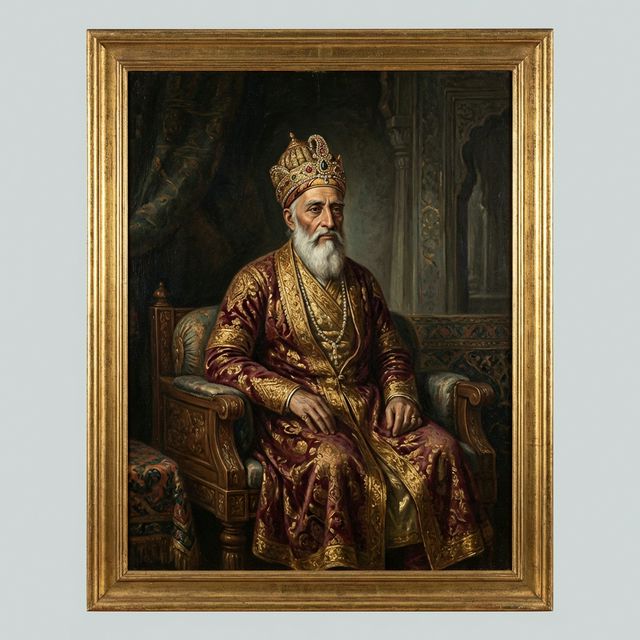
In Indian popular culture, Bahadur Shah Zafar occupies a peculiar position — he is simultaneously remembered as a tragic poet-king, a brave freedom fighter, and a symbol of Hindu-Muslim unity. His couplet "Lagta nahin hai ji mera ujde dayar mein" — lamenting his exile from Delhi — has become perhaps the most quoted verse in Indian political discourse about the loss of sovereignty.
Bollywood has repeatedly romanticized him. NCERT textbooks present him as a leader of India's "First War of Independence." Streets, parks, and institutions across India bear his name. The narrative is consistent: a noble emperor who bravely stood against British imperialism.
But what do the actual historical records say?
By the time Bahadur Shah Zafar ascended the Mughal throne in 1837, the empire had long ceased to exist as a political entity. His authority was confined to the walled city of Delhi, and even that was nominal. He survived entirely on a monthly pension of ₹1 lakh provided by the British East India Company.
The British referred to him as a "titular Emperor" — essentially a state-funded figurehead whose continued existence served British administrative convenience. His status was described by contemporaries as "barely above that of a beggar."
When the sepoys from Meerut arrived at the gates of Delhi on May 11, 1857, Bahadur Shah Zafar did not heroically rally them. Historical accounts — including his own trial testimony — describe him as confused, frightened, and reluctant.
The sepoys essentially forced his endorsement, understanding that they needed a symbolic Mughal authority to legitimize their rebellion. Zafar, at 81 years old and with no military experience, had neither the means nor the will to lead an armed uprising.
Perhaps the most damning evidence against the "freedom fighter" narrative comes from Zafar's own correspondence. During the 1857 revolt, while publicly endorsing the rebels, he secretly wrote letters to British officers, providing intelligence about sepoy positions and offering to help suppress the rebellion.
His personal physician, Hakim Ahsanullah Khan, confirmed this during the trial, testifying that Zafar maintained backdoor communications with the British throughout the revolt.
Detailed historical analysis from the Dharma Dispatch characterizes Bahadur Shah Zafar as a "weakling" and "traitor" who displayed an "aversion to everything that was heroic and valorous." The analysis argues that his portrayal as a freedom fighter is a "romanticized myth" created for political purposes. Source: dharmadispatch.in
The glorification of Bahadur Shah Zafar is not merely an academic question. It is part of a larger pattern in Indian historiography where Mughal rulers are systematically romanticized while their documented atrocities — temple destructions, Jizya taxation, forced conversions — are whitewashed or ignored.
This selective history serves specific political narratives, but it comes at the cost of historical truth. Every Indian citizen deserves to know the complete, documented record — not just the version curated for political convenience.
Continue to the next chapter to see the full timeline of events →